Keyword Research for SEO in 2026: The Complete Data-Driven Guide to Ranking, Traffic, and AI Search Visibility

Jarno S.
SEO- & AEO-strategi | AEOvara perustaja
Olen tekoälyajan hakukoneoptimoinnin (AEO) asiantuntija, joka auttaa yrityksiä löytymään sieltä, mistä vastauksia nykyään etsitään.

Keyword research has evolved from a simple process of finding search volume into a strategic discipline that determines whether content earns visibility across Google, AI Overviews, ChatGPT-style answer engines, voice assistants, and transactional search surfaces.
Today, ranking for broad keywords alone is no longer enough. We must identify search demand, understand user intent, measure competitiveness, predict click potential, and build topic authority that performs across both traditional search engines and AI-driven discovery systems.
This guide outlines a modern framework for keyword research in 2026 that drives rankings, traffic, leads, and sustainable organic growth.
Table of Contents
- What Keyword Research Means Today
- Why Keyword Research Still Matters in the AI Era
- Core Metrics That Determine Keyword Value
- Search Intent Analysis Framework
- Head Terms vs Long-Tail Keywords
- Keyword Discovery Process
- Competitor Keyword Gap Analysis
- Local Keyword Research Strategy
- Keyword Clustering for Topical Authority
- Prompt Research for AI Search Engines
- How to Prioritize Keywords That Drive Revenue
- Keyword Research Workflow Step-by-Step
- Mistakes That Destroy Rankings
- Best Tools for Keyword Research
- Final Strategic Recommendations
What Keyword Research Means Today
Keyword research is the process of identifying, evaluating, and prioritizing search queries users enter into:
- Bing
- YouTube
- Amazon
- Maps
- Voice assistants
- AI tools such as ChatGPT, Gemini, and Perplexity
Modern keyword research focuses on three goals:
- Visibility – appearing when users search
- Clicks – earning traffic from search results
- Conversions – attracting users ready to act
The strongest SEO campaigns no longer target random keywords. They build structured topic ecosystems aligned with real user demand.
Why Keyword Research Still Matters in the AI Era
Many assume AI-generated answers reduce the need for SEO. The opposite is true.
As AI surfaces summarize content, only trusted, comprehensive, well-structured sources get cited or influence outputs.
That means keyword research now determines:
- Which topics deserve investment
- Which queries still generate clicks
- Which searches trigger AI summaries
- Which long-tail searches lead to conversions
- Which topics build authority over time
Without keyword research, content production becomes guesswork.
Core Metrics That Determine Keyword Value
Every keyword should be scored across four dimensions.
1. Search Volume
Estimated monthly searches.
Higher volume can mean larger opportunity, but not always better ROI.
Example:
| Keyword | Volume | Intent |
|---|---|---|
| shoes | High | Broad |
| waterproof trail running shoes men | Low | High purchase intent |
2. Keyword Difficulty
Measures competitiveness based on ranking domains, backlinks, authority, and SERP strength.
Low-authority websites should prioritize easier opportunities first.
3. Search Intent
Why users search.
A keyword with clear commercial intent often outperforms higher-volume informational terms.
4. Click Potential
Some keywords generate low clicks due to:
- AI Overviews
- Featured snippets
- Instant answers
- Maps packs
- Product widgets
Ranking #1 is meaningless if nobody clicks.
Search Intent Analysis Framework
Google ranks pages matching intent, not just keyword phrases.
We classify intent into four categories.
Informational
Users want knowledge.
Examples:
- how to do keyword research
- seo checklist
- what is domain authority
Best content types:
- Guides
- Tutorials
- Explainers
Navigational
Users seek a brand or destination.
Examples:
- ahrefs login
- semrush pricing
- google search console
Commercial Investigation
Users compare before buying.
Examples:
- best keyword research tools
- semrush vs ahrefs
- best crm for startups
Best formats:
- Comparisons
- Reviews
- Roundups
Transactional
Users are ready to act.
Examples:
- buy standing desk
- hire seo consultant
- keyword research service pricing
Best formats:
- Service pages
- Product pages
- Landing pages
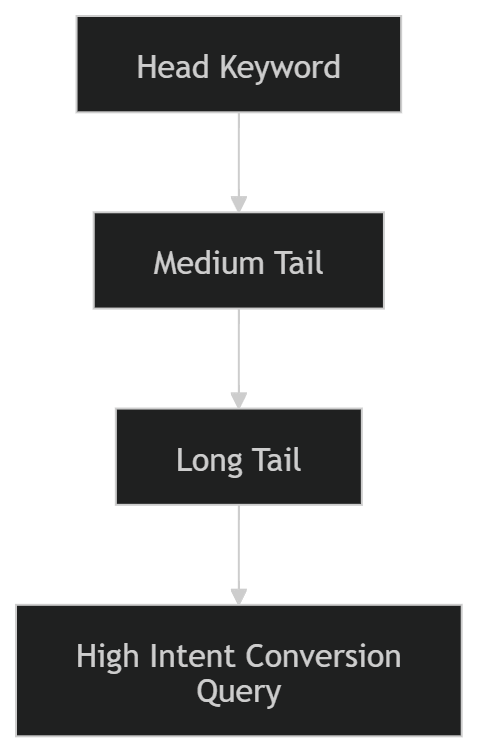
Head Terms vs Long-Tail Keywords
Head Terms
Short, broad keywords.
Examples:
- seo
- marketing
- shoes
Advantages:
- High traffic potential
Disadvantages:
- Extreme competition
- Weak intent clarity
- Lower conversion rates
Long-Tail Keywords
Specific phrases with clearer intent.
Examples:
- keyword research for ecommerce stores
- best waterproof hiking boots wide feet
- seo consultant for dentists helsinki
Advantages:
- Easier rankings
- Higher conversions
- Better alignment with voice and AI queries
Keyword Discovery Process
We use a layered discovery model.
Step 1: Build Seed Topics
Start with business categories, products, services, and customer pain points.
Example for an SEO agency:
- keyword research
- local seo
- link building
- technical seo
- ecommerce seo
Step 2: Expand Variants
Use tools to extract:
- Questions
- Comparisons
- Modifiers
- Geographic terms
- Use-case phrases
Examples:
- keyword research tools free
- keyword research for beginners
- keyword research template excel
Step 3: Mine SERPs
Study:
- People Also Ask
- Related Searches
- Auto-suggest
- Reddit discussions
- Forum language
This often reveals intent patterns tools miss.
Competitor Keyword Gap Analysis
One of the fastest growth strategies is identifying terms competitors rank for that you do not.
Process
- Identify 3–5 true organic competitors
- Export ranking keywords
- Filter by relevance
- Remove branded terms
- Prioritize attainable gaps
Best Opportunities Often Include:
- Comparison terms
- Niche use-case keywords
- Long-tail commercial searches
- Topic clusters competitors partially cover
Local Keyword Research Strategy
Local SEO requires geographic intent mapping.
Examples:
- seo agency helsinki
- wedding photographer espoo
- gym near kamppi
- accountant vantaa small business
Expand with Modifiers
- near me
- best
- affordable
- open now
- same day
- emergency
Local Ranking Signals
Keyword targeting alone is insufficient.
We also optimize:
- Google Business Profile
- Reviews
- NAP consistency
- Location pages
- Local backlinks
Keyword Clustering for Topical Authority
Modern SEO rewards depth.
Instead of publishing isolated pages, we build clusters.
Example Cluster: Keyword Research
Pillar Page
- Keyword Research Guide
Supporting Pages
- Free keyword research tools
- Keyword difficulty explained
- Long-tail keyword strategy
- Local keyword research
- Keyword clustering tutorial
- AI prompt research for SEO

Prompt Research for AI Search Engines
Users interact differently with AI tools.
Traditional query:
best email marketing tool
AI prompt:
I run a Shopify store and need an affordable email platform with automation and SMS. What do you recommend?
This means content must answer layered needs:
- Persona
- Context
- Constraints
- Desired outcome
How We Optimize for AI Search
We create pages containing:
- Direct answers
- Structured comparisons
- Scenario-based recommendations
- FAQs
- Decision frameworks
- Updated data points
This improves discoverability in LLM-generated responses.
How to Prioritize Keywords That Drive Revenue
Traffic without commercial value wastes resources.
We score keywords using:
Priority = Intent x Relevance x Attainability x Conversion Potential
Example
| Keyword | Volume | Difficulty | Intent | Priority |
|---|---|---|---|---|
| seo tips | High | High | Low | Medium |
| seo consultant helsinki | Medium | Medium | High | Very High |
| keyword research service | Low | Low | Very High | High |
Keyword Research Workflow Step-by-Step
Phase 1: Discovery
Generate 500–2,000 raw keyword ideas.
Phase 2: Filtering
Remove:
- Irrelevant terms
- Misaligned intent
- Impossible difficulty
Phase 3: Categorization
Group by:
- Funnel stage
- Topic
- Intent
- Geography
- Device behavior
Phase 4: Mapping
Assign one primary keyword per page and multiple semantic support terms.
Phase 5: Publishing
Create superior content aligned to intent.
Phase 6: Monitoring
Track:
- Rankings
- CTR
- Conversion rate
- Impression growth
- Cannibalization
Mistakes That Destroy Rankings
Chasing Volume Only
High volume often means low ROI.
Ignoring Intent
A product page cannot rank for tutorial intent.
Targeting the Same Keyword on Multiple Pages
Creates cannibalization.
Publishing Thin Content
Search engines reward complete solutions.
Neglecting Internal Linking
Clusters need connective structure.
Ignoring AI SERP Features
Some keywords lose clicks despite rankings.
Best Tools for Keyword Research
Premium Platforms
- Ahrefs
- Semrush
- SE Ranking
- Moz Pro
Google Sources
- Google Search Console
- Google Trends
- Keyword Planner
AI & Prompt Discovery
- ChatGPT query simulation
- Perplexity trend prompts
- Reddit mining
- Forum scraping tools
Advanced Keyword Research Tactics for 2026
Seasonal Intent Forecasting
Build pages months before demand peaks.
SERP Volatility Tracking
Target unstable results where incumbents are weak.
Click Curve Modeling
Estimate traffic from real CTR, not rank alone.
Entity Expansion
Optimize for entities related to the topic, not just exact keywords.
Zero-Volume Commercial Terms
Many tools underreport profitable B2B searches.
Final Strategic Recommendations
Keyword research in 2026 is no longer about spreadsheets full of phrases. It is a revenue intelligence system.
We win when we target:
- Search terms with measurable demand
- Intent we can satisfy better than competitors
- Difficulty levels we can realistically beat
- Topic clusters that build authority
- AI-compatible content structures
The websites dominating tomorrow’s rankings are not publishing more pages. They are choosing smarter keywords and executing deeper content.
If we consistently align keyword strategy with user intent, SERP realities, and topic authority, rankings become a byproduct of precision.
Frequently Asked Questions
What is the best keyword research strategy?
A combination of intent analysis, competitor gap discovery, long-tail targeting, and topic clustering.
Are long-tail keywords still valuable?
Yes. They often convert better and align with voice search and AI prompts.
How many keywords should one page target?
One primary keyword plus multiple semantically related secondary terms.
Is keyword research still important with AI Overviews?
More than ever, because only authoritative and intent-matched content gains visibility.
How often should keyword research be updated?
Quarterly for stable industries, monthly for competitive or fast-changing markets.
Kirjoittajasta

Miltä yrityksesi näyttää AI-haussa?
Tilaa 15 minuutin maksuton AI-auditointi ja selvitä nykytilanteesi.
Varaa auditointi tästä →- Miksi AI-näkyvyys ratkaisee yhä useammin sen, kenet asiakas valitsee LVI-alalla?
- Keyword Research for SEO in 2026: The Complete Data-Driven Guide to Ranking, Traffic, and AI Search Visibility
- Maksettu haku on muuttunut – mitä LLM-murros oikeasti tarkoittaa?
- Miksi sivusi ei näy Googlessa? 7 yleisintä syytä (ja miten korjaan ne SEO-analyysissä)
- Yrityksen mainostaminen Googlessa – kannattaako Google-mainonta oikeasti vuonna 2026?